In the sun-scorched, perpetually festive open world of Forza Horizon 5, where the roar of hypercars is the universal language and the asphalt shimmers like a heat-stricken python, a ghostly legend haunts the accolades menu. Its name is whispered in tuning garages and screamed into headsets during Festival Playlist crunch time: the Daredevil Skill. As of 2026, long after the initial wave of Horizon Mexico tourists have fled, the hardcore purists remain, and for them, this electronic badge of honor is no mere notification; it is a sacred rite, a fleeting, high-velocity tango with twisted metal and fate. Yet, much like capturing lightning in a bottle woven from carbon fiber mesh, the game’s arcade soul offers no manual for this particular sorcery. The skill remains an enigma, rarely stumbled upon by accident, demanding a pilgrimage to a specific strip of blessed tarmac where the algorithm’s heart beats loudest.
The true initiate understands that this endeavor is a precise alchemy of velocity and spatial calculus. The philosophical core of the Daredevil Skill rejects brute force; it is not about outrunning a rival or shattering a speed trap with the ferocity of a meteor riding a laser beam. The recipe, decoded by the community’s most obsessive ghost racers, requires a player to weave through the world’s NPC traffic like a surgical needle passing through silk. Specifically, the ghost in the machine only grants the "Daredevil" title when a driver chains three unequivocal "Near Miss" skills in relentless, rapid succession. Not two near misses followed by a lazy drift tap, but a holy trinity of closeness that makes the car’s paint molecules scream in silent terror. The vehicle must brush past three civilian cars, generating a synapse-snapping proximity alert each time, without the cataclysmic shriek of carbon fiber meeting a slow-moving Volkswagen Beetle. The achievement is not a reward for patience; it is a fleeting window of chaotic perfection.
For the 2026 speed mystic, the howling pilgrimage ground has remained unchanged since launch day: the grand highway bisecting the Mexican map. This is not just a road; it is the game’s central nervous system, a four-lane artery that functions as a colossal, linear daredevil dojo. The optimal strategy is to treat this highway like a two-way particle accelerator. The driver marks a waypoint on the far end of the map, allowing the GPS arrows to paint a holy guiding path. However, the true artist of the \"Ultimate Near Miss\" operates against the cosmic grain. They ignore the suggested lane entirely, throwing their machine into the oncoming lane. This act transforms the highway into a high-speed game of chicken, where the density of oncoming headlights increases the statistical probability of chain-triggering the required near-miss events. It is a realm where the slipstream smells of burnt ozone and digital anxiety.
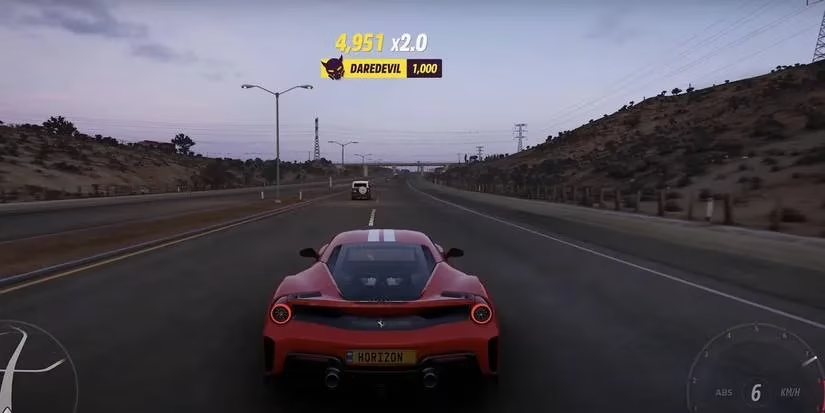
However, the biggest adversary in 2026 is not the oncoming traffic but the dreaded silence of an empty server. The game’s dynamic traffic spawning can occasionally turn the bustling superhighway into a desolate, sun-baked ghost town. Should a driver find themselves screaming down pavement devoid of targets, the solution is a metaphysical fast-travel ritual. One must blink to a distant location on the map—perhaps the dense urban sprawl of Guanajuato—and then instantly fast-travel back to the highway’s entrance. This digital hiccup resets the spawning logic, populating the road with fresh metal fodder. If the world remains stubbornly vacant, the modern ritual demands a harder reset: switching the Horizon Life session to Solo mode, completely closing the application, and purging the system’s Quick Resume cache to force a clean, cold boot. This purges the spectral connection bugs that, even now, occasionally haunt the lobbies, ensuring the NPCs materialize with the density of a rush-hour nightmare.
The choice of instrument for this high-octane surgery is a subject of heated debate, but the logic of physics is immutable. Unless bound by a seasonal challenge restricting vehicle class, the daredevil in 2026 gravitates towards the absolute zenith of automotive engineering—the rocket ships of the S2 and X classes. The reason is simple: speed warps time. The faster a vehicle travels, the more ground it covers, and the more rear bumpers it passes per microsecond, making the three-miss chain a trivial footnote in a blur of kinetic energy. A hypercar with the downforce of a supersonic vacuum cleaner and a 0-60 time measured in milliseconds can accumulate “Ultimate Speed” acknowledgments while simultaneously brushing past traffic. Yet, this is a Faustian bargain; the same velocity that makes the task manageable also turns the slightest control twitch into a fireball of shame, intensifying the risk of a crash that evaporates a 2-million-skill-score chain instantly.
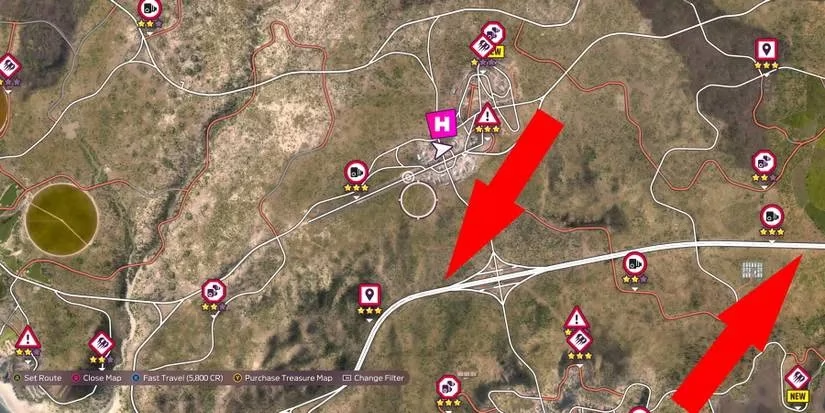
Ultimately, securing this accolade in the current era of 2026 is a reflection of mastery over the game’s raw, simulated chaos. It represents a completion percentage that separates the casual tourist from the festival legend. The highway runs are a zen meditation, a series of calculated near-tragedies played out at 270 miles per hour. For those still chasing seasonal playlists or specific Accolade completion, this is no longer a trivial nuisance but a badge of persistence. The technique, unchanged since the game’s inception, remains a flawless exercise in controlled aggression, proving that while the accolades evolve and the car list swells, the heart-pounding thrill of a perfectly executed chain of near-miss skills against oncoming traffic remains the quintessential Forza Horizon 5 experience.