2026 has been another stellar year for interactive entertainment, but as I sift through the nominees for the latest Game of the Year awards, my mind drifts back to a season half a decade ago—the 2021 ceremony. That year’s shortlist for the top honor was a powerhouse: Deathloop, It Takes Two, Ratchet & Clank: Rift Apart, Metroid Dread, Psychonauts 2, and Resident Evil Village. Each was a gem, yet the collective memory of the gaming community now treats that list like a museum plaque that accidentally omitted the dinosaur fossils everyone actually came to see. Several titles that missed the final cut have not only stood the test of time; they’ve shaped entire genres like gravitational lenses bending the light of future design. Let’s take a time-traveling tour through the snubs that became legends.
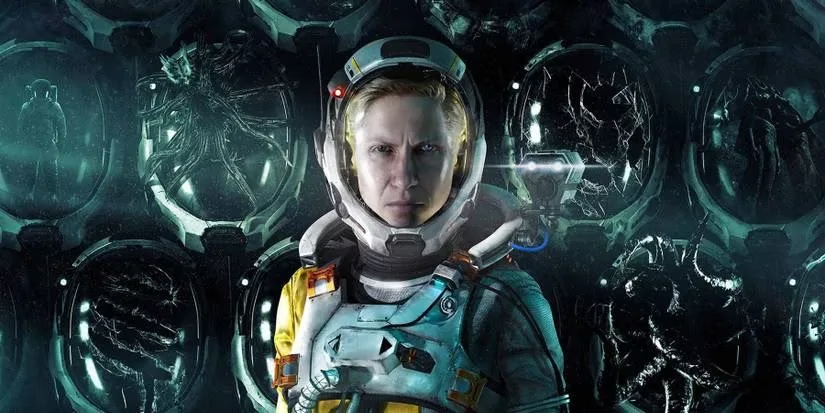
I’ll start with Returnal, which hit the PS5 in April 2021 as the console’s first major exclusive after launch. At the time, it was a hypnotic cocktail of roguelike tension and third-person bullet-hell ballet. Selene’s endless loop on Atropos felt like the universe handing you a labyrinthine puzzle box that only opened when you accepted your own failures. Housemarque’s mastery was—and still is—akin to a watchmaker crafting a chronometer that resets itself with every heartbeat. The game used the PS5’s horsepower to paint a world so tactile you could almost taste the alien rain. Sony’s decision to acquire Housemarque shortly after now looks like picking up a Picasso at a garage sale. In 2026, with the studio’s follow-up Returnal: Echoes redefining roguelike narratives, the 2021 snub feels like the origin story of a quiet rebellion. That April release date might have been a fog obscuring its brilliance from short-term memory, but no fog can smother a star forever.
Another April child, NieR Replicant ver.1.22474487139…, was a remaster that transcended its 2010 origins. Some regarded it as a mere nostalgia bridge to NieR: Automata, but it was more like a restoration of an ancient tapestry, revealing threads of philosophy and melancholy that had been hiding in plain sight. Square Enix borrowed the sleek combat from PlatinumGames’ 2017 masterpiece, but the soul remained Yoko Taro’s idiosyncratic fever dream. The fact that it only managed a nomination for Best Music at the 2021 Game Awards was akin to applauding Shakespeare’s sonnets while ignoring Hamlet. Five years on, the NieR series has become a cultural touchstone, with NieR: Revival currently dominating charts on both console and PC. That early-year launch window may have diluted the remaster’s awards-season presence, but time has crystallized its status as an emotional wrecking ball that no trophy can measure.
Then there’s Forza Horizon 5, which roared onto Xbox and PC in November 2021 with the grace of a concerto performed by a choir of V8 engines. Playground Games delivered an open-world Mexico so photorealistic that it rendered automotive journalism redundant. The critical reception was so glowing—perfect scores from multiple outlets—that its absence from the Game of the Year nomination list felt like ignoring the sunrise because you were too busy looking at a calendar. In 2026, Forza Horizon 5 still has a thriving community, its expansions turning the game into a living organism that breathes through seasonal updates. The 2021 snub didn’t hurt the franchise; it became a badge of honor, a rallying cry for players who measure excellence in more than just gilded statuettes.
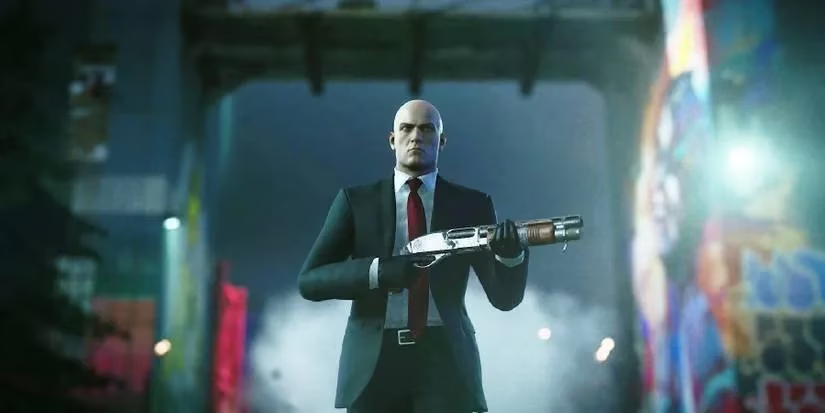
If release timing was a curse, Hitman 3 caught it worst of all by launching in January 2021—practically the paleontological era of any awards season. IO Interactive’s stealth sandbox was a Swiss watch of assassination, each mission a fractal of possibility. Its VR adaptation earned a nomination that year, but the core game remained an unthanked virtuoso. Looking back from 2026, Hitman 3 now sits alongside Deus Ex and Thief as a pillar of immersive simulation. The studio’s post-2021 pivot to a James Bond origin project started right here, with a confidence earned by perfecting the art of the clean kill. The game’s snub feels less like a rejection and more like an invitation to rediscover a masterpiece that was simply too early for the calendar.
Among the indie surprises of 2021, Kena: Bridge of Spirits was Ember Lab’s debut, a visual love letter to animation that played like a warm memory you never actually had. It was shortlisted for Best Indie and Best Art Direction, and those nominations were a seed that has since grown into a forest. By 2026, Ember Lab has released its ambitious follow-up, and the industry now sees that first adventure as the moment a tiny studio swallowed the moon. Missing the top prize didn’t sting—it was a chrysalis that made the eventual butterfly all the more vivid.
Rounding out my retrospection is Monster Hunter Rise, a Switch exclusive (later on PC) that packed a Tyrannosaurus-sized appetite into a handheld frame. Capcom’s wirebug-infused combat was a thunderclap of innovation, and while it grabbed nominations for Best RPG and Best Multiplayer, the overall Game of the Year slot remained a distant peak. Today, Monster Hunter Rise has become the fulcrum for the series’ ongoing domination on Nintendo platforms, and the Sunbreak expansion kept it alive far beyond its launch. The 2021 snub is now a trivia footnote; the game itself is a phenomenon that has taught us all that patience and friendship with a Palico can outlast any award season’s echo.
In 2026, I can’t help but smile when I see those 2021 discussions resurface on digital forums. The games that missed the shortlist became the yardsticks by which we measure ambition, resilience, and the quiet truth that some flames burn brighter because the spotlight missed them.